Sunday, April 3, 2016
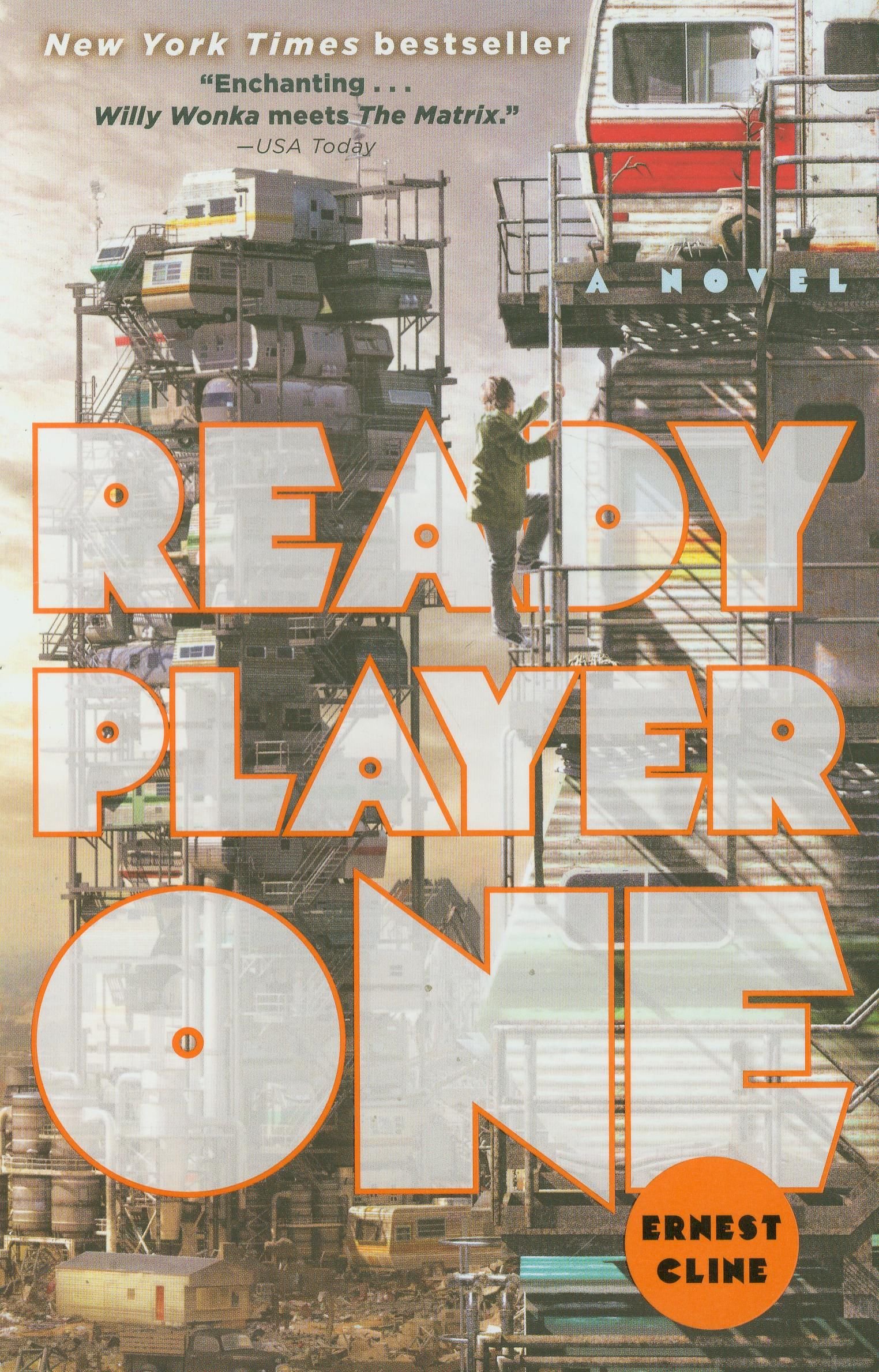
Book Club: Ready Player One
The basic premise of Ernest Cline's Ready Player One is that of a great modern sci-fi story. In a post not quite apocalyptic but somehow affected by climate change world, the most popular pastime is a virtual reality video game accessible to all people. The game's creator, billionaire James Halliday, dies and leaves his fortune hidden somewhere within the game. Whoever finds the treasure gets the money. As an elevator pitch, it's tremendously effective. It makes all the sense in the world that Steven Spielberg is directing the film adaptation. Typically this type of treatment happens with worthwhile stories. Ready Player One stops being one worth reading after the tenth page.
There's plenty to be frustrated about in the novel. The dialogue, the character interactions, the lack of character development, the unimaginative story arc, the insensitivity to race. Let's start with the 80s references. Before Halliday passes, he publishes an almanac of all his interests, potentially with clues to the location of the keys that lead to the treasure. What is supposed to be a collection of personal interests is actually a summary of anything and everything culturally relevant during the 1980s. Here's what Cline gets completely wrong about how pop culture works. While it's not uncommon for a person to have interests across several mediums, it's close to impossible for someone to profess a love for an array of video games as accessible as Pac-Man and Donkey Kong and as obscure as text-based adventure games, coupled with obsessions with Ferris Bueller's Day Off and The Breakfast Club and then a craze for the band Rush. There are people that admit to liking everything, but someone, let alone a video game designer egotistical enough to publish a book of all the shit he likes, would never like everything. All the name drops of 80s phenomenon are cheap pulls for nostalgia for, one would assume, 40+ year olds looking for young adult science fiction? If anything, it makes the film production that much more difficult and expensive, given all the clearances.
The obsession with the hunt and as a result the almanac results in the modern world becoming entirely obsessed specifically with 80s movies, music and TV. Again, that's not how pop culture works. There's a point in which Wade, the protagonist, bemoans the modern era corny sitcom that's constantly on TV and then chooses to binge Family Ties, a real television show. But how can you expect the writer to understand any of this when an actual sentence in this book describing Halliday's favorite directors goes, "Spielberg, Lucas, Tarantino...and, of course, Kevin Smith." Cline also wrote the movie Fanboys. Do with that information what you will.
There are three keys that lead to three gates, the last of which guards the treasure. It's a pretty standard storytelling structure. Whenever the players are stuck solving answers to clues that lead to the next key, however, there's no callback to something previously established or reference to lore established within the universe. Every single time, Wade simply remembers some video game that had never been mentioned previously or some other random trivia from the almanac and that's it, he solves the riddle. Every time.
If you're trying to do a Hunger Games and put together a story that doesn't really make that much sense but has characters you can root for simply based on the fact that they're trying to win a contest and beat a villain – a corporation that wants to monetize the (currently free) video game, then fine I get it. It gets the job done. I don't totally fault you for ignoring some of the more interesting possible themes given the premises: the future of technology and virtual reality, consequences of lack of human contact, love in a virtual world, racism in virtual reality, class issues in the real world. Why bother with those topics when the dialogue reads like it was written by a child, or someone that never attended a school, or spoke to a member of the opposite sex as a teenager, or participated in any sort of competition? Why even touch on how pop culture permeates in a world in which so many choose to exist in a virtual setting when a scene describes Wade downloading a how-to-dance tutorial for his avatar so the avatar can appear to be moving to the music correctly and this is viewed by others as something that is cool to do. Fuck this book.
Monday, February 15, 2016
Kanye West - The Life of Pablo
We're far enough in Kanye West's discography at this point that the comparisons and the rankings conversations become more complex. And while they're all great and necessary and impactful in their own way, the conversation is important because Kanye is one of the few artists today and probably the only rapper to literally disregard everything that he had done before, revamp and find a way to push music and the culture forward with each new album. We're also two albums into a time period where music may not be 100% his sole focus. There's the clothing lines, the ambitions to run established clothing empires, Donda, attempts to fund Donda. It took over a year to get this album from the release of the first single. Part of that was probably figuring out a direction, but you don't have a year's worth (2 songs, but still) of false starts without some distractions.
And yet this album sounds nothing like "Only One" or "All Day," to the point where you have to imagine it may have mostly been created in the last month or so. We essentially saw the album be finalized from the sidelines based on Kanye's tweets. And now that the album is out, it's a weird thing to think about. The album is good and there are songs that are great, but it's also much more disjoint and almost random than any other Kanye album. Personally I think an album being "cohesive" is totally overrated, but "Ultralight Beam" into a rap about bleached asshole into a solo song by Fake Future?
In the past, it was safe to assume every decision on every Kanye album was intentional and vetted by a committee. With Yeezus, Rick Rubin said that many songs were recorded in the final week before deadline, but in retrospect that album seems much more focused than it did on the initial listen. So I've learned to trust Kanye, and again, the product is solid. But in its current form – it was literally in flux until the final hour – I can't tell if this is the way it is by chance or because of the deadline or entirely randomly. Or maybe it still is entirely intentional and Kanye has the ability to see the bigger picture at all parts of the process. Even the title. To go from Swish to Waves to The Life of Pablo. Does he see the album as symbolically similar to Picasso's works as a whole, to a specific Picasso piece? Does he just really like Pablo Picasso? Is he even talking about Picasso? Every Kanye album is very representative of how Kanye felt at that moment of time, but this album is representative of this literal two week span.
I love "Ultralight Beam." I love "FML" and "Fade." "Father Stretch My Hands Pt. 1" is fire right up until the verse. You've got to appreciate "I Love Kanye." I can't be the only one confused by the presence of Desiigner. "Wolves" is still not that interesting. "30 Hours" and "No More Parties in LA" sound great but feel weird here even as bonus tracks. Every Ye verse being about sex and sex with women that may or may not be his wife in language that is ridiculous and so totally misogynist is weird and strange but so Kanye. Everything he does is honest and honestly flawed.
Saturday, December 19, 2015
Some quick thoughts on Star Wars: The Force Awakens
SPOILERS SPOILERS SPOILERS:
As soon as the credits rolled, I couldn’t help but think, “Huh. So that...was it?” I’ll watch it again next week, but there was a lot going through my head during and after seeing it so here are some quick thoughts.
First, what I liked. Finn and Rey are great characters, played by fine actors. I loved their introduction, their dynamic and how they were generally used. I realize now we got a lot more out of them than we ever did out of Luke, Leia or Han but obviously these characters mirror qualities in those three. I didn’t like how fan service-y the first trailer was, but I ended up totally liking how involved Han and Chewie were (but that’s probably because of what happens to Han). The visuals were fine. I like that there were jokes, but it was maybe a bit too much for my liking. I could change my mind about that later. Miles from Lost! Lupita Nyong’o as Maz Kanata was great. I loved that character and her line about people’s eyes. Han dying was an interesting twist. I kind of figured Ren was his son (Kylo/Solo).
I enjoyed most of the movie, but I didn’t really like how the whole last third of the movie was handled. Yes, the movie was an exact rehash of Episode IV. Yes, it was the easiest of the three to do. And there’s story left to conquer with the next two and the one-offs also. But I wanted a real movie not just a jumpoff point.
That final lightsaber fight didn’t seem like a final battle to me. I checked the time around that point thinking there’s got to be another 45 minutes left, right? Even if Ren is mid-training, shouldn’t he whoop both of their asses? If you handed me a sword right now and asked me to fight, I would be killed immediately. And for the Death Star/battle station/whatever to just blow up that easily felt really cheap. They probably cut a lot at the end, but it still felt rushed.
Ren taking his mask off twice was weird because Driver has such a baby face and to hear his voice without the mask and voice effect reminded me of Rick Moranis as Darth Helmet. I almost laughed at that scene where Ren and Rey are trying to out-force each other. People would have clowned Lucas for doing the same thing.
It was weird seeing a talented actor as Oscar Isaac work in such a limited role.
Another Death Star? It’s bigger and destroys more planets at a time but planets that we as viewers have no connection to whatsoever?
If it takes my iPhone at least an hour to charge, it should have taken like six weeks for that battle station to charge regardless of how powerful the sun was.
Don’t like Snoke portrayed as this large figure. I get that it’s a hologram, but that’ll ruin things when we see him in person and he’ll obviously be smaller.
Do no intergalactic contractors build handrails onto their elevated walkways???
When they showed the AT-ATs on the desert planet, I couldn't help but think, "Man, climate change has really done a number on Hoth."
If you’re going to redo the desert planet, forest planet, ice planet trope, how you gonna end on the ice planet?
R2D2 jumps alive then and there...because?
Captain Phasma gotta be fired.
That final scene. I feel like it would be more of a twist if Rey wasn’t Luke’s daughter but that scene was strange. To literally end the movie with a helicopter shot of Rey holding out the lightsaber like five feet away from Luke. And he doesn’t grab it or move closer or anything? Just continues to stand there. Why was he standing there? He doesn’t have a house or a cave or a Playstation or anything. There was literally nothing else on that island. We’re supposed to believe he’s been standing there for some number of years? Though, this does raise interesting questions about the interactions of this whole family and when and where Ben turning, Rey’s abandonment, Han and Leia’s split all fit in.
It’s easy to clown Lucas’s prequels but it’s way easier to write a sequel to 4,5 and 6 than it would have been to write prequels. At least the prequels had some new elements to them.
Theories:
Like I said before, you can do a lot with Han/Leia/Ren/Luke/Rey as one big family how the disconnect occurs. The arc of the three movies seems like it will be Ren going from bad guy to good guy, but can you really just redo Vader’s storyline? Obviously lots of story to cover, but it’ll interesting to see how Rey’s flashbacks(/future visions???) turn out. There’s lots of history to cover too. I’m sure Luke trained other Jedi. Where did the First Order originate? Why does the Rebellion have so few ships? What hair product does Poe Dameron use? I didn’t really like
Wednesday, November 11, 2015
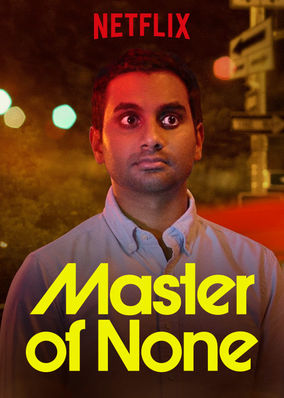
TV Recap: Master of None
The reaction to Aziz Ansari's new show Master of None has been so overwhelmingly positive, it's easy to forget that no one expected the show to be what it is. Aziz and his co-creator Alan Yang came from Parks and Rec, a lovable, single cam mockumentary. Mike Schur, one of Master's producers, worked on Parks and also Brooklyn Nine Nine, which has the same format. Unbreakable Kimmy Schmidt, Netflix's only other half-hour comedy isn't quite that but has a similar aesthetic feel to both of those. It was safe to assume that Aziz would follow suit with his show.
The other aspect was how ubiquitous he had become as a comic. His last special, while taped at Madison Square Garden, wasn't his best to put it politely. Would the show be more of that mediocrity? But the show is a significant marker in his career. Aziz has had four hour-long specials in six years, all before he turned 32. He starred on an NBC sitcom for seven years. He wrote and starred in his own major movie. He is literally one of the most successful comics out, but he's never been considered the guy. This was a chance for him to quiet naysaysers.
The show is good. It is shot beautifully. It makes New York look so warm and welcoming in a way that no big city could ever be. I love that episodes revolve around these candid conversations, with shots of people just walking and talking. The music fits in really well. Then, of course, there are the special episodes: "Parents," "Old People," "Indians on TV." My parents are immigrants from India. I understand the emotional distance that exists within an Indian family. I'm sure that episode — and the fact that it was so early in the series — hit home for many. What separates this show from a Louie or Girls is that it views these topics in an optimistic manner. And there is a conscious decision to focus on that topic and not just Dev's relation to that topic. It's fun for me to see people of color on screen. It's fun for me to see Indian people on screen. It's cool to see an interracial romantic relationship played out on screen where one of people isn't white or black.
But this show isn't the end all be all of the minorities on TV problem. It definitely isn't the blueprint to fixing the problem. Dev has an Asian friend Brian, but Brian is really only used in the episode "Parents". Eric, the white friend, is in almost every other episode. All of Dev's romantic interests are white. The one that's not is an Asian girl that was only on the date for the free food. Outside of Aziz's mom, there are no Indian women in the show at all. It's difficult to see how this kind of thing was overlooked in the writer's room. I get that it's his show and it's semi-autobiographical, but these things do matter. There's little things too. His name is Dev Shah, which is a name that's easy for white people to say, but it would also make him Gujarati which means his family wouldn't speak Tamil. Maybe this isn't the show to establish the nuances of Indian culture to an American audience, but you don't have to brush those things to the side either, even if the show is less about the Indian American experience and more about a single dude that hangs out with friends and likes tacos.
I do appreciate the depths of the show. I've been so jaded by 30 Rock style pacing, it almost made me uncomfortable to hear the (noticeably long) pauses in conversations. Normal people don't talk like that, right? But it is funny. And it is enjoyable. Also, I need to get into acting if commercial actors really get paid enough to live in an apartment that nice.
Monday, November 2, 2015
Top 25: Hi-Tek
There are soul beats, generally attributed to Just Blaze, Kanye West and the like in which songs from the 70s are chopped, looped and at times sped up, and then there are beats that touch your soul. That trigger a frequency in your brain and the rest of your body to feel a sensation so pure you wonder why anyone would spend the rest of his life listening to anything different. For most of my formative years, Hi-Tek helped me experience the latter feeling. Tek was a magician with a drum machine, melding vocal samples, bass lines and drums in a way that few in rap had done before. And while a Just Blaze or a Bink could make something hard and turn around and make something smooth, few producers could generate a beat with a palpable sense of melancholy like Hi-Tek. Take Snoop Dogg's "I Believe In You." It's a sad beat, but it's a happy beat. You have the hi-hat and rimshot combo for most of the drum loop paired with a guitar part that implies sorrow or mourning, but then those shakers and that oh-so-beautiful clap come in at the third bar to make everything feel better again.
Not a lot of producers experienced celebratory underground status and major commercial success like Hi-Tek. He grew up in Cincinnati — and you can probably make a Midwest Dilla connection in terms of the soul stuff but they do have pretty established differences* — but he's mostly known for his work with Rawkus Records in New York. He produced five songs on Mos Def and Talib Kweli's Blackstar album and he has assorted credits throughout the Soundbombing series, but he's easily most famous for his and Kweli's Reflection Eternal album (the first one, anyway) and its lead single "The Blast."
*If anything, you can probably make the Pete Rock comparison but they all obviously come from the same lineage.
In 2002, he received a call from Dr. Dre asking permission to use the beat for what would become "Hollywood" for Truth Hurts' debut. That sparked his relationship with Aftermath where he would contribute to albums by 50 Cent, G-Unit, Lloyd Banks, Young Buck, The Game (twice), Snoop Dogg (twice) and D12, albums that would go on to sell 11 million, 5.5 million, 4 million, 5 hundred thousand, 5 million, 2.3 million, 1 million, 1 million and 2 million copies, respectively, though none of his songs were ever singles. In 2009 when three or four T.I. references for what was then Detox leaked, one of them, "Coming Back", was done by Hi-Tek and I stand by the fact that that song and the rest of that batch were better than anything on Compton.
He also released three solo albums that featured him rapping* even though he was never really known for that and a bunch of his friends that were much more famous than him. They were kind of like DJ Khaled albums but not as good and he actually contributed something to them. Hi-Teknology 2 is one of those middle of the road albums that doesn't really exist anymore but for nostalgic reasons means a lot to a certain type of person on the Internet. I'm one of those people, but to be fair 2006 was a hell of a year for that kind of fan. While I still wait for that unreleased Dion album, here are Hi-Tek's 25 best beats.
*Apparently all written by Smoke DZA.
Listen on Spotify.
Hi-Tek Top 25:
1. Reflection Eternal - The Blast
2. Bishop Lamont - Friends*^
3. Snoop Dogg – I Believe In You (feat. Latoiya Williams)
4. The Game – Runnin' (feat. Tony Yayo)
5. Dr. Dre – Coming Back (feat. T.I.) [T.I. reference]*^
6. 50 Cent – Ryder Music
7. Hi-Tek - Come Get It (Tekstrumentals)
8. The Game - Ol' English (feat. Dion)
9. Hi-Tek - Music for Life (feat. J. Dilla, Nas, Common, Busta Rhymes & Marsha Ambrosius)
10. Reflection Eternal – Love Language
11. Reflection Eternal – Good Mourning
12. Styles P – Testify (feat. Talib Kweli)^
13. Hi-Tek – Step Ya Game Up (Remix) [feat. Little Brother & Dion]
14. Cormega – Take These Jewels
15. Hi-Tek – The Sun God (feat. Common & Vinia Mojica)
16. Styles P – Let's Go (feat. Ray J)
17. The Game - Letter To The King (feat. Nas)
18. Reflection Eternal – Back Again (feat. RES)
19. Hi-Tek – Josephine (feat. Ghostface Killah, The Willie Cottrell Band & Pretty Ugly)
20. Hi-Tek – Know Me (feat. Jonell)
21. Hi-Tek – Baby We Can Do It (feat. Czar-Nok)
22. Black Star – Respiration
23. Common – 1-9-9-9 (feat. Sadat X & Talib Kweli)
24. G-Unit – G-Unit
25. Tha Eastsidaz – Eastside Ridaz (feat. Snoop Dogg, LaToiya Williams, Nate Dogg & Soopafly)
* Not released officially
^ Not on Spotify
Previous Top 25 Lists:
Cool & Dre
Monday, October 19, 2015
TV Recap: Red Oaks
Amazon has an interesting collection of original video programming. They have all the money in the world but continue to fund shows that USA or TNT would air. Which in itself is not fair because most of the TV watching public loves absolute garbage TV. But as a brand name, even as a second tier, they have never come even close to the level of excitement Netflix's shows can provide. I'm not even sure how many people realize Prime shipping also happens to come with all these streamable options. There is hope for Amazon though. The Man in the High Castle pilot was really great and the full show debuts next month. And they did pay Woody Allen a lot of money, so I'm not sure he can weasel out of that agreement.
Red Oaks, like Betas, is an enjoyable show, a notch or two above that USA level. That almost sounds like a harsh critique, but, again, I liked it. In fact I watched every episode in an afternoon. The shows follows David, a rising college junior home for the summer working as a tennis instructor at a country club set in the 80s. Richard Kind plays his father. Paul Reiser plays the owner of the country club. Like Betas, it's maybe technically a comedy, but it's not a show that's focused on a jokes. It simply follows this small group of people for different days throughout the summer.
What drives the show forward are the different scenarios of boy has girlfriend A but realizes he's interested in girl B. But the show seems to be more ambitious than that. It just never actually does. In the first episode, David's dad has a heart attack and admits to David that he should have married someone else and that his wife might be a lesbian. There are some marriage counseling scenes, but it's not fully explored. So why mention it at all? Then there's the career dilemma. David's dad wants him to be an accountant but that's something he'd rather not do. Again, touched on but not much else beyond that.
At its heart, it's a bunch of kids shirking responsibilities figuring themselves out. But also, it's a bunch of white kids working at a country club. Shout out to the Indian comic from Guy Code that got a two second cameo delivering flowers.
Thursday, October 15, 2015
Top 25: Cool & Dre
Cool & Dre are an interesting case study. The duo were never superstar producers. They had two major hits in 2004 and 2005 with "New York" and "Hate It or Love It" and a small handful of top 40 hits after that with Juvenile, Christina Milian and The Game and Lil Wayne. But they've managed to not only stay working but to do so in a way that still actually matters. They never ended up doing beats for random dudes on Koch.
Way more often than not, the music – or at the very least, their contribution – is so great. I can count on one hand songs they did that I'm not necessarily celebrating ("Lights Get Low", anything that has involved Nas...). They use samples freely. They do entirely original music. Rap. R&B. They can write hooks. Dre can sing hooks. They've done soul beats. They even had their 80s glam rock period with synths and brite pianos ("100 Million", "The Crack House", "Make The World Go Round", "World Tour"). There is a richness and texture to their music, a completeness that never feels like too much. It can be radio ready but remains true to an aesthetic.
I'd say that the only left for them to accomplish would be to bring in a new artist or produce an entire album, but they've tried to do both of those things. They produced that entire Christina Milian album when she was dating Dre, and you can totally forget about that one. The first single was a fake "Hate It or Love It" and the second single was a fake "Stay Fly." And randomly enough, they produced the entire Queen Latifah comeback album in 2009 and I don't know what the fuck that one was. It would have been cool if things worked out with Don Trip, but let's blame that one on Interscope.
In 2015, no artist is coming to them for a single, but it's amazing the relationships they've maintained over the years. They've worked steadily with Rick Ross, Lil Wayne, The Game, DJ Khaled and Fat Joe. The Runners, Danja, shit even J.U.S.T.I.C.E. League aren't doing anything like that. The amazing thing about this list and their discography in general is how much those five artists overlap among it. It was really a great time to record in Miami from 2005 to 2009. I'd love to see Young Thug or Vince Staples over a Cool & Dre beat. Meek, Kendrick, Drake, maybe even Jay-Z. For now, let's celebrate their legacy as it stands. This is, this is, this is...
Listen on Spotify (except "Holla At Me" because Koch is garbage and the Jay Rock song which for whatever reason is no longer streamable)
Cool & Dre Top 25:
1. Brown Paper Bag (DJ Khaled)
2. Hate It Or Love It (The Game)
3. New York (Ja Rule)
4. Rodeo (Juvenile)
5. 100 Million (Birdman)
6. Holla At Me (DJ Khaled)
7. Take Me Home (Terror Squad)
8. Let's Just Do It (Joe)
9. All My Life (Jay Rock)
10. Blow (Rick Ross)
11. Prove Something (Fat Joe)
12. Da Da Da (Lil Wayne)
13. Confessions (8Ball & MJG)
14. Loyalty (Fat Joe)
15. Forgot About Me (Scarface)
16. Valley of Death (Fat Joe)
17. On Fire (Lil Wayne)
18. Born In The Ghetto (Fat Joe)
19. Big Dreams (The Game)
20. Ashamed (Rick Ross)
21. The Crack House (Fat Joe)
22. Good Girls Go Bad (The Game)
23. So Special (Lil Wayne)
24. Let It Show (Tyga)
25. All That (The Game)
Subscribe to:
Posts (Atom)